
The Weil European Distress Index
The latest Weil European Distress Index (WEDI), an indicator of corporate distress and an early-warning indicator of default risk, shows that distress across Europe eased in the latest quarter, while remaining above the long-run average.
The overall index fell to +2.7 in August from +2.8 in May, reversing some of the deterioration recorded earlier in the year and leaving distress broadly unchanged from August 2025. The data suggests European corporates have absorbed some of the initial shock from the conflict in the Middle East better than feared, supported by more resilient economic activity and relatively supportive financial markets.
Euro Area GDP grew by 0.6% in Q2, its strongest quarterly performance since Q2 2022. However, the operating environment remains challenging. Inflation rose to 3.3% in August, while producer prices were 5.8% higher year-on-year in July, pointing to continued cost pressure. Profitability, investment and liquidity also remain elevated sources of distress across European businesses.
Sector spotlight
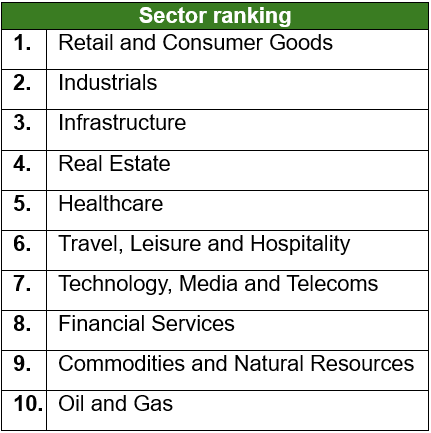
- Retail and Consumer Goods: Remains by far the most distressed sector, with the index rising to +8.1 in August from +6.0 a year earlier. Distress rose on both the quarter and the year, with profitability, investment, liquidity and valuation under pressure. Elevated inflation, pressure on personal finances and fragile consumer confidence continue to weigh on discretionary spending, while higher energy, transport and financing costs are squeezing margins and cash flow.
- Industrials: Remains the second most distressed sector. Distress eased slightly on the quarter, although underlying pressures remain persistent. Stronger manufacturing activity and export demand have provided some support, but profitability and investment remain under strain, with higher energy costs and tighter credit conditions continuing to weigh on the sector.
- Infrastructure, Utilities and Power: Infrastructure remains the third most distressed sector at +3.8, up sharply from -0.5 a year earlier, despite some easing during the latest quarter. Investment and risk remain the main sources of distress, while capital-intensive operators continue to face challenging financing conditions, higher project costs and uncertainty around delivery.
- Travel, Leisure and Hospitality: Distress has moved above the long-run average, rising sharply on both the quarter and the year to +1.2, up from -2.1 a year earlier. While demand across travel and accommodation has remained relatively resilient, higher fuel, wage, energy and other operating costs are increasingly squeezing margins, alongside continued geopolitical uncertainty.
Regional spotlight
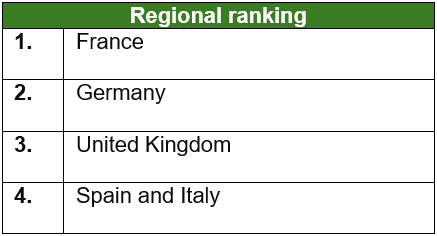
- France: France has overtaken Germany to become the most distressed market covered by the WEDI. Distress was unchanged on the quarter at +4.8 but has risen from +3.4 a year earlier. Profitability is the largest source of distress, followed by investment and liquidity. The macroeconomic backdrop remains weak: GDP was flat in Q2, unemployment rose to 8.3%, its highest level since 2020, and the IMF has cut its 2026 growth forecast to 0.6%. Corporate insolvencies also remain elevated, with 70,605 business failures recorded in the 12 months to July.
- Germany: Germany is now the second most distressed market, with distress easing to +4.4 from +4.8 in the previous quarter, although it remains higher than a year earlier. GDP grew by 0.3% in Q2 and business sentiment has strengthened, but the recovery remains fragile. Corporate insolvencies reached their highest quarterly level since 2005 in Q2, while higher energy costs and restrictive lending conditions continue to weigh on businesses.
- United Kingdom: Corporate distress eased to +4.0 from +4.4 in the previous quarter, although it remains above the +3.6 recorded a year earlier. The economy has proved more resilient than expected, with GDP growing by 0.4% in Q2 and business investment rising by 1.7%. The IMF has raised its 2026 UK growth forecast to 1.0%, but financing costs remain a significant source of pressure, particularly for smaller businesses.
- Spain and Italy: Spain and Italy remain the least distressed of the markets covered by the WEDI, with the combined index falling slightly to -0.2 and remaining below its level a year earlier. However, the headline continues to mask a divergence between the two economies. Spain continues to benefit from stronger domestic growth, with GDP expanding 0.7% quarter-on-quarter in Q2, while Italy recorded more modest growth of 0.2%. Inflation nevertheless remains a pressure point in both markets.
Looking ahead
The latest data points to resilience rather than recovery. European businesses have so far weathered the initial economic and market disruption from the Middle East conflict better than feared, against a backdrop of stronger economic activity and relatively resilient financial markets.
However, the improvement remains fragile. Distress is still above the long-run average, cost pressures remain elevated and profitability, investment and liquidity continue to weigh on businesses. Higher energy costs, restrictive borrowing conditions and rising insolvencies mean corporate balance sheets remain under pressure.
Andrew Wilkinson, Partner and Head of Weil’s London Restructuring practice, said:“The latest data suggests businesses have absorbed the first wave of geopolitical and economic disruption better than many expected. But resilience should not be mistaken for recovery. Distress remains above normal levels, and financing conditions are still challenging. If borrowing costs remain elevated while demand and margins stay under pressure, we could see this continued level of distress begin to feed through into higher default rates across Europe.”
Jenny Davidson, Partner in Weil’s London Restructuring practice, added: “France remains a place to watch, as is Germany. The sector picture shows retail distress at its highest level since the Global Financial Crisis, but the nature of that distress is very different. Profitability and liquidity now play a much greater role as retailers contend with higher costs, rising interest rates and uneven consumer demand. If those pressures persist as the upcoming maturity wall is hit, we are likely to see a widening gap between businesses with the balance-sheet flexibility to absorb them and those with much less room for manoeuvre.”
Contributor(s)





More from the Weil European Restructuring Blog


This website is maintained by Weil, Gotshal & Manges LLP in New York, NY © 2020 Weil, Gotshal & Manges LLP, All Rights Reserved. The contents of this website may contain attorney advertising under the laws of various states. Quotation with attribution is permitted. This publication is provided for general information purposes only and is not intended to cover every aspect of the purpose for the law. The information in this publication does not constitute the legal or other professional advice of Weil London or the authors. The views expressed in this publication reflect those of the authors and are not necessarily the views of Weil London or of its clients. These materials may contain attorney advertising. Prior results do not guarantee a similar outcome.